
Every trip has that moment. You lift the esky lid somewhere past Norseman, and the ice you bought two days ago is now a warm puddle with your bread floating in it. The mince has gone off, the milk turned this morning, and dinner just became whatever the roadhouse still has under the heat lamp.
That's the problem the iFROST range was built to solve — properly, not with a bigger esky and more ice. Four models, from a 31L drawer unit through to a 95L dual zone, running from around $499 to $899.

 Fast & reliable shippingFast delivery from our Perth and QLD warehouses.
 Legendary supportNeed help? Speak to an Aussie Power Expert.
 30-day money-back guaranteeNot happy? Return it within 30 days.
 Proudly Australian100% Aussie-owned and operated.
What Makes an iFROST Different to an Esky
An iFROST is a compressor fridge. It works the same way the fridge in your kitchen does — a compressor cycles refrigerant through a closed loop, pulls the heat out, then switches itself off until it's needed again. No ice, no meltwater, no guessing.
That matters more than it sounds. A thermoelectric cooler, the sort you plug into the cigarette socket, can only get so far below whatever the air around it is doing. Park that in a 4WD in February and it's fighting a losing battle. A compressor fridge holds the temperature you set it to, whether it's 18°C outside or 42°C.
The whole iFROST range is designed and tested in Australia, for Australian conditions — corrugations, red dust, coastal salt, and long stretches where the nearest shop is several hours behind you. Thick insulation keeps the cold in so the compressor isn't running constantly, which is what keeps the draw on your battery low.
The iFROST range, out where it actually gets used.
There are four models. They aren't four rungs on a ladder where the expensive one is simply the good one. They're four different shapes built around four different ways of travelling.
How the Four Sit Against Each Other
Capacity is the obvious starting point, so here's the range laid out by volume before we get into which one actually suits you.
The jump from 40L to 75L is the big one, and it's not only about volume — it's where the range switches from a single temperature to two independent compartments. More on that shortly.
Which iFROST Is Right for You?
Forget litres for a second and picture where the fridge is actually going to sit, and what you'll be asking of it. That's usually what decides it.

iFROST 31L Drawer
You're building out a canopy, ute tub or drawer system
This one isn't designed to be carried anywhere. It's designed to be installed and forgotten about. At 250mm tall it slides in under a false floor or into a drawer run where a chest fridge simply wouldn't fit, and it pulls out on full-extension steel rails so you can reach the back without unpacking the front.
A heavy-duty stainless slam latch keeps it shut over corrugations, and the stainless mounting kit comes in the box. It holds around 29 cans with removable dividers, runs on 12V or 24V, and sips power at 0.4A on average. If you're running two, they stack.

iFROST 40L
You want one fridge that moves with you
At 17kg the 40L is the one you'll actually pick up. Out of the wagon, onto the campsite table, into the boat, back into the shed between trips. The lid is fully reversible so you can open it from whichever side you've parked it, which matters more than you'd think once it's wedged in beside the gear.
It's also the only model in the range that takes an optional internal battery, so it can run with no vehicle and no dual battery system at all. Plug it into 240V at home to pre-cool, run it off 12V on the road, or top it up from solar. Roughly 57 cans.

iFROST 75L
You're touring for weeks, not weekends
This is where the range gains its second compartment. Fridge on one side, freezer on the other, each set independently anywhere from −20°C to 20°C. Frozen meat for week two of the trip, cold drinks for tonight, in the one unit.
It's the efficiency sweet spot too. Nearly double the capacity of the 40L for an average draw of 1A against 0.8A — so the extra room costs you far less battery than the size difference suggests. ECO mode watches your vehicle's voltage and cuts out before it flattens the battery you need to start the car with. Around 128 cans.

iFROST 95L
You're feeding a family a long way from the shops
The biggest in the range, and the one that changes how you plan a trip. At 95L across two independent zones you're shopping for a fortnight rather than topping up every few days — which, when the nearest supermarket is a 400km round trip, is the entire point.
Dual lids open from either side, and it'll hold roughly 144 cans. It asks more of your power system than the others at 1.5A average, so it suits setups with a decent battery bank and solar behind it rather than a single starter battery.
The Four at a Glance
Swipe to compare
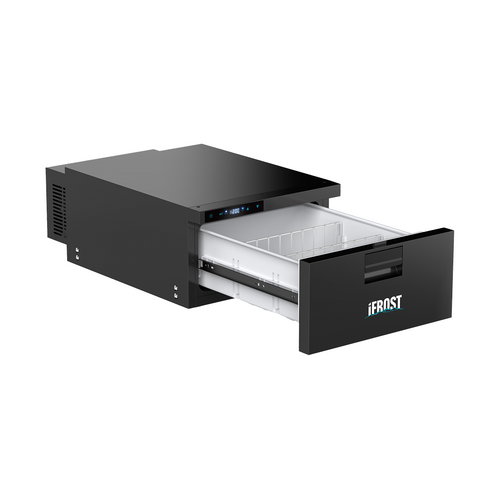
31L Drawer
Canopies & drawer systems
$499
Installed once and slides out. Built for setups where height is the constraint.
- Zones
- Single
- Cans
- 29
- Height
- 250mm
- Weight
- 18.1kg
- 12V average
- 0.4A
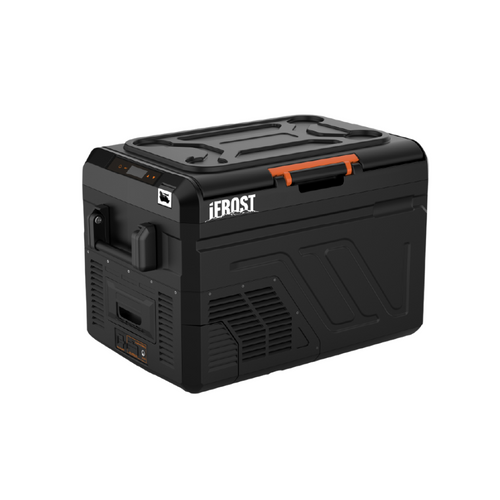
40L
Weekends & moving between vehicles
$599
The one you carry. Reversible lid, and an optional battery so it runs on its own.
- Zones
- Single
- Cans
- 57
- Height
- 440mm
- Weight
- 17kg
- 12V average
- 0.8A
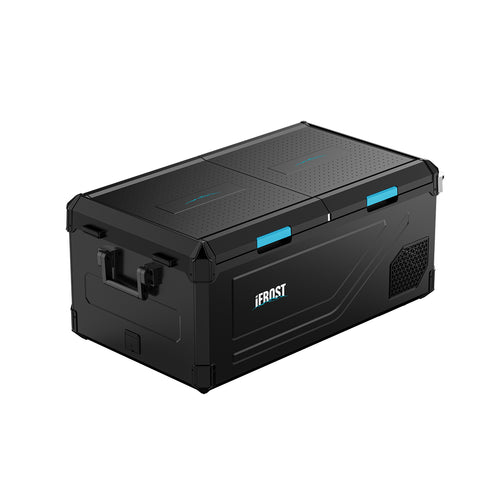
75L
Extended touring & caravans
$849
Fridge and freezer at once, for barely more power than the 40L.
- Zones
- Dual
- Cans
- 128
- Height
- 415mm
- Weight
- 27.1kg
- 12V average
- 1A
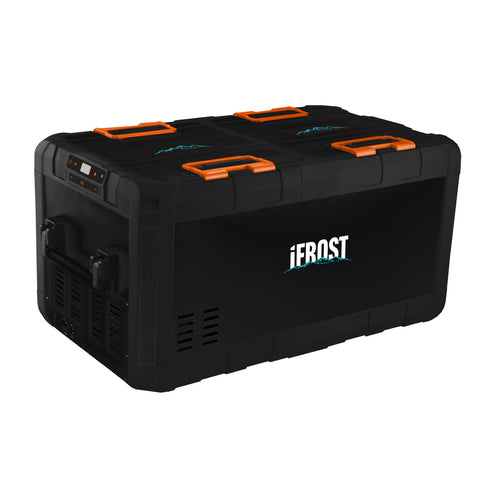
95L
Families & remote travel
$899
Shop for a fortnight. Two zones, dual-opening lids, the most room in the range.
- Zones
- Dual
- Cans
- 144
- Height
- 467mm
- Weight
- 27kg
- 12V average
- 1.5A
Will It Flatten My Car Battery?
This is the question we get more than any other, and it's a fair one. The honest answer is that it depends far less on the fridge than on what you're plugging it into.
A compressor fridge doesn't run flat out all day. It works until it hits your set temperature, switches off, and waits. That cycling is why the average figures are so low — the 31L sits at 0.4A, the 95L at 1.5A. Over a full day that's roughly 10Ah to 36Ah depending on the model.
The catch is what that's coming out of. Your vehicle's starter battery is built to deliver a big burst of current for a few seconds, not to be slowly drained overnight. Take much more than a third out of it and you're gambling on it turning the engine over in the morning. One night parked up with a fridge running might be fine. Two nights often isn't.
The fix isn't a smaller fridge, it's a second power source. A dual battery setup with a DC-DC charger tops up a dedicated deep cycle battery while you drive, and leaves your starter battery untouched. A portable power station does the same job without any wiring. The 40L can also take an optional internal battery, which sidesteps the question entirely for short trips.
The 75L adds another layer of protection: in ECO mode it monitors your vehicle's voltage and cuts power before the battery drops too low to start the car. It's a genuinely useful safety net if you're running straight off a single battery.
What Owners Say
Across the range, 137 reviews average 4.85 out of 5. Here's what comes up most.
“Ran on car power and when I shut down it automatically changed to its own battery. At 4 degrees it ran for 24 hours with 2 bars left.”
“Great little fridge, freezer hardly drawing any power set on −12 degrees.”
“Love the space and easy access with the detachable lids. USB to charge my phone which is great.”
Reviews collected through Okendo from verified buyers. Quotes trimmed for length, wording unchanged.
What It'll Cost You in Battery
Working from a full 120Ah lithium battery with nothing else running, you'd get somewhere around twelve days out of the 31L, six from the 40L, five from the 75L and three from the 95L.
Going bigger costs less power than most people assume. The 75L holds nearly double what the 40L does but averages 1A against 0.8A. Capacity and power draw don't scale together — so don't talk yourself into a smaller fridge on the assumption a bigger one will flatten your setup.
Add solar and the maths changes again. On a decent day a fridge on its own is a modest load for even a small blanket. It's everything running alongside it — lights, water pump, charging phones, the Starlink — that usually decides how much solar you need, not the fridge.
Worth knowing: those average figures are measured under test conditions. In 40°C with the lid opening every twenty minutes while the kids raid it for icy poles, real draw climbs. Pre-cool at home before you leave, keep it shaded, and keep the vents clear, and you'll land much closer to the published numbers.
Worth Adding
A few things that make a fridge easier to live with once it's in the vehicle.
iFROST 40L Fridge Slide
Pulls the fridge clear of the vehicle so you can open the lid properly, instead of leaning over it.
iFROST 75L Fridge Slide
Built to take the 75L fully loaded, with the same full-extension access.
iFROST 95L Fridge Slide
Heavier duty again, sized for the weight of the 95L when it's packed out.
iFROST 40L Insulated Cover
Adds insulation and takes the knocks, dust and sun so the fridge itself doesn't.
iFROST 20.8Ah Battery
Clips into the 40L so it keeps running with the engine off and the vehicle elsewhere.
31L Drawer Stacking Kit
Mounts two 31L drawers in one column — 62L across two separately controlled zones.
Quick FAQs
What's the difference between single zone and dual zone?
A single zone fridge runs at one temperature — you set it as a fridge or a freezer, but not both. The 31L and 40L are single zone. Dual zone means two separate compartments with their own temperature controls, so one side chills and the other freezes at the same time. That's the 75L and 95L.
Will it flatten my car battery overnight?
Running straight off your starter battery, one night is usually fine and two often isn't — starter batteries aren't built for slow deep discharge. A dual battery setup, a DC-DC charger or a portable power station solves it properly. The 75L also has a low-voltage cut-out in ECO mode that protects your ability to start the car.
Which ones can I pre-cool at home on mains power?
The 40L and 95L both accept 240V, so you can run them off a wall socket the night before you leave. The 31L Drawer runs on 12V and 24V DC, so it pre-cools from a battery or a power station instead.
Can I stack two of the 31L drawers?
Yes, with the stacking kit. That gives you 62L across two separately controlled drawers in one column — a genuine alternative to a single large dual zone unit if your build suits drawers better than a chest.
How do I know it'll fit?
Measure all three dimensions of the space, not just the width. The 31L has a larger floor footprint than the 40L but is 190mm shorter, and the 75L is longer than the 95L despite being the smaller fridge. The full dimensions are on each product page.
Picking Yours
Start with where it's going to live, because that narrows it fastest. Then ask whether you need a fridge and a freezer running at the same time — that splits the range cleanly down the middle. Capacity is the last thing to settle, not the first.
Still weighing it up? Give us a bell on 1300 483 249 or email sales@itechworld.com.au and one of our Power Experts will size it with you — no offshore call centres, just people who've done the trip. Or browse the full iFROST fridge freezer range online.


